
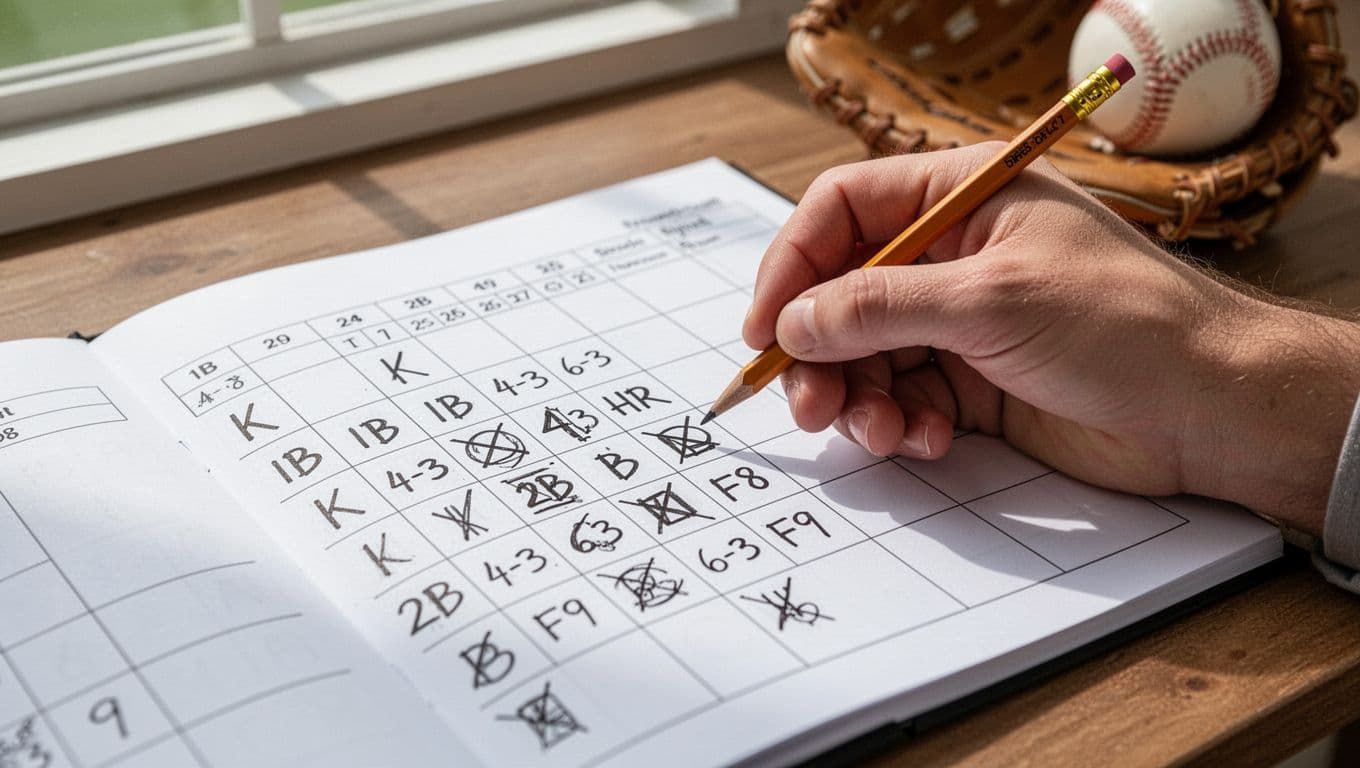

Softball Scorekeeping Parents: Symbols and Game Sheet
Keeping a softball scorebook can feel like learning a new language, especially when you're also cheering, filming, and finding the snack bag. The good news is that softball scorekeeping doesn't need to be perfect to be useful.
In youth fastpitch, a clear book helps everyone. Coaches confirm who's up next, umpires can check counts and substitutions, and families get a clean record of what happened. Many leagues also treat the home team's book as the official record, whether it's on paper or in an app, so it pays to be consistent.
What parents should track (and what you can skip)
Start by deciding what "good enough" means for your team. For most rec games, you only need the basics: who batted, how they reached, where runners advanced, and how outs happened. If you can do that, you're already ahead of the chaos.
In many youth leagues, the home team keeps the official book and the visitors run the scoreboard. Either way, it helps to compare notes at the inning break so the score and outs match. That habit prevents the most common late-game confusion: "Wait, is that two outs or three?"
Here's the simplest workflow that works in real time:
- Write the lineup (player name, number if you have it, and a defensive position).
- For each batter, record the result (hit, walk, strikeout, out, reach on error).
- Mark runner movement with lines from base to base, then circle runs.
- Write outs clearly, because outs end innings, not hits.
If your league uses an app, you can still keep paper as backup. Apps are fast, but paper is easy to audit when someone asks, "How did she get to second?" For digital training help, GameChanger has a practical guide and printable resources in its baseball and softball scorekeeping training.
One last mindset shift helps a lot: you're not writing a novel, you're making a map. Clear marks beat pretty marks.
Easy softball scorekeeping symbols that cover most innings
Most scorebooks use the same foundation because the sport is standardized nationwide (USA Softball is the national governing body and supports a network that reaches well over a million participants). So once you learn a small set of symbols, you can walk into almost any park and follow along.
Use this quick-reference table as your "starter kit." It's enough for the majority of rec games.
| What happened | Write this | What it means in plain English |
|---|---|---|
| Strikeout swinging | ꓘ (backward K) | Third strike called |
| Walk | BB | Batter took ball four |
| Hit by pitch | HBP (or HP) | Batter awarded first base |
| Single, double, triple | 1B, 2B, 3B | Batter hit and reached that base |
| Home run | HR | Batter scored on the hit |
| Reached on error | E + fielder | Defense made a mistake |
| Fielder's choice | FC | Defense made an out, batter reached base |
| Stolen base | SB | Runner advanced on a steal |
| Caught stealing | CS | Runner out trying to steal |
To score outs, you'll also need position numbers (these are universal for both softball and baseball):
- Pitcher (P) = 1
- Catcher (C) = 2
- First base (1B) = 3
- Second base (2B) = 4
- Third base (3B) = 5
- Short stop (SS) = 6
- Left field (LF) = 7
- Center field (CF) = 8
- Right field (RF) = 9
Keep two pencils. Use one for the live play, the other for quick fixes between batters. Ink turns small mistakes into big ones.
If you want a one-page cheat sheet to keep in your bag, this beginner-friendly PDF is a solid backup: scorekeeping for first timers (PDF).
The fastest way to feel confident is to master the plays that repeat all game. A few patterns show up constantly in softball.
- Groundout (example: 6-3 or 4-3)
- If the shortstop fields it and throws to first, write 6-3. If second base fields it and throws to first, write 4-3. In the scorebox, draw a line toward first and mark the out at first (many people use an X at the end of the basepath).
- Flyout (example: F8)
- If center field catches it, write F8. Right field is F9, left field is F7. Pop-ups to the infield can be written as F1 through F6 depending on who caught it.
- Strikeout plus dropped third strike (if your rules allow it)
- Some youth rules treat the batter as out no matter what. Others allow the batter to run if first base is open (or with two outs). If your league uses that rule, write K and then score the play that gets the out or shows the batter safe. When in doubt, follow your local rules and ask between innings.
- Stolen base (SB) and wild pitch (WP)
- If the runner goes on the pitch, write SB2 for a steal of second. If the pitch gets away and the runner advances, mark WP on the pitch line or near the runner's path. Many youth innings include both, so don't overthink it, just record what moved the runner.
A common parent mistake is giving a hit when the defense made the play but missed it. When a routine out gets booted, score E. Hits are for balls that beat the defense.
Want a reminder of why outfield catches and smart throws matter so much on the scoreboard? Read this quick perspective on outfielders as softball heroes, it connects the "quiet" plays to real runs saved.
A one-game practice sheet you can copy and use tonight
Practice scorekeeping is easiest when you remove pressure. So try this for one game: tell yourself you're only tracking (1) who reached base and (2) how outs happened. That's it. You can add pitch counts later.
Below is a simple one-game sheet you can recreate on paper in two minutes. Draw one row per lineup spot. Use seven columns for innings (or fewer if your league plays six). In each box, write the result: BB, K, 1B, E6, 6-3, F8, and so on. Then draw basepath lines only when runners advance.
| Lineup Spot | Player | 1 | 2 | 3 | 4 | 5 | 6 |
|---|---|---|---|---|---|---|---|
| 1 | |||||||
| 2 | |||||||
| 3 | |||||||
| 4 | |||||||
| 5 | |||||||
| 6 | |||||||
| 7 | |||||||
| 8 | |||||||
| 9 |
If you'd rather print a ready-made template, this option is straightforward: free printable softball scorebook sheet.
Also, scorekeeping gets easier when you understand what "good contact" looks like. If your player wants extra reps, this local guide to best batting cages in Western Massachusetts can help you plan practice that shows up in the next scorebook.
Conclusion
Softball scorekeeping for parents comes down to a small set of symbols and a calm routine. Track each plate appearance, record outs clearly, and mark runner movement in a consistent way.
Over time, your book becomes a clean story of the game, not a stressful puzzle. Bring your sheet to the next game, keep it simple, and you'll be surprised how fast scorekeeping starts to feel natural.